By early afternoon, a commercial roof can feel like a landscape separated from the building beneath it. Mechanical equipment hums against an open sky. Pipes, curbs, drains, vents, and flashing cast short shadows across a surface with almost no shelter from the sun. From the parking lot below, the roof may be nearly invisible. Up here, however, it is the building’s first uninterrupted encounter with weather.
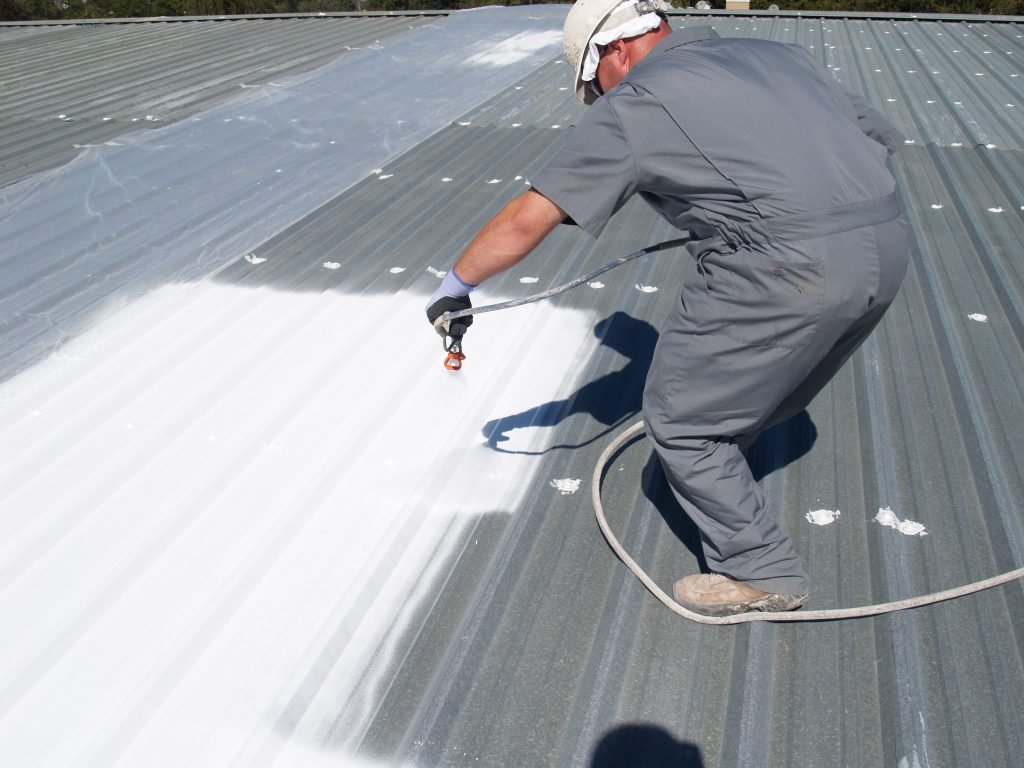
This is the environment in which Reflective Roof Coatings are asked to perform. Their purpose is often summarized with a simple phrase—reflect more sunlight—yet the actual story is more nuanced. A commercial roof must interact with solar energy while simultaneously resisting rain, accommodating penetrations, directing water toward drainage, tolerating rooftop activity, and remaining compatible with the assembly beneath it.
A reflective coating changes one important part of that relationship. Instead of absorbing as much of the solar energy arriving at the roof surface, a highly reflective surface can send a greater portion back toward the sky. That difference is measurable. But it belongs within a larger building system, and understanding that distinction is where an intelligent coating strategy begins.
“A roof does more than keep rain outside. Every clear day, it also stands between the building and the energy arriving from the sky.”
Chapter One: The Roof Beneath the Sun
Solar reflectance sounds technical, but the principle is remarkably direct. When sunlight reaches a roof, some of that solar energy is reflected and some is absorbed. Solar reflectance describes the fraction that is reflected. A surface with a higher tested reflectance sends a greater proportion of incoming solar energy away from the roof rather than absorbing it at the surface.
This is one reason bright, reflective commercial roof surfaces have become visually associated with cool-roof strategies. Their appearance tells part of the story, but color alone is not the complete performance specification. The relevant values should come from testing and product documentation for the actual material being considered.
There is another property in the conversation: thermal emittance. Once a roof absorbs heat, thermal emittance describes its ability to release thermal energy through radiation. Solar reflectance and thermal emittance therefore describe different aspects of surface behavior. One concerns how much incoming solar energy is reflected; the other concerns how effectively absorbed heat can be emitted.
These concepts matter because the roof is an enormous environmental boundary. On a large warehouse, retail property, office building, or industrial facility, thousands of square feet may be exposed to sunlight simultaneously. Changing the surface properties changes how that boundary interacts with solar energy.
Yet this is precisely where careful language becomes important. A reflective roof is not an energy-savings percentage painted onto a building.
Actual building energy consumption depends on far more than the roof’s reflectance. Climate matters. Insulation matters. HVAC design and efficiency matter. Occupancy, operating schedules, internal heat loads, building geometry, roof area, and existing construction all influence the result. Two buildings using the same reflective coating can therefore experience different thermal and energy outcomes.
The responsible way to describe reflectivity is not to promise a universal reduction in utility bills. It is to recognize that a tested reflective surface changes a measurable property of the roof and can form part of a broader strategy for managing solar heat gain.
Reflectivity changes the behavior of the roof surface. It does not rewrite the physics of the entire building.
That distinction becomes even more important when restoration is involved. Before discussing how brilliantly a finished roof might reflect the afternoon sun, one must ask a more fundamental question: is the existing roof suitable to receive the coating in the first place?
A weathered surface may remain a viable restoration candidate after proper evaluation and preparation. Another roof may conceal moisture-related concerns, deteriorated materials, incompatible substrates, or broader conditions that require a different approach. The brightness of the proposed finish cannot answer those questions.
The roof must be understood before it can be transformed.
Chapter Two: The Thin Line Between Weather and the Building
The character of the roof changes when clouds gather. Sunlight is no longer the dominant force; water is. What had been a question of reflected and absorbed energy becomes a question of continuity. Rain reaches the roof field, gathers around penetrations, moves toward drains and scuppers, encounters curbs and transitions, and tests every place where one material or plane meets another.
This is where the second role of a coating system becomes easier to appreciate. Applied over a suitable and properly prepared roof, a compatible fluid-applied system can create a continuous protective surface. But Waterproof Roof Protection is not achieved merely because a broad field of roofing appears seamless.
A commercial roof is filled with interruptions. HVAC equipment rises from curbs. Plumbing vents pass through the assembly. Electrical conduits cross the surface. Walls and parapets create vertical transitions. Drains deliberately interrupt the roof because water must leave somewhere. Perimeter conditions define where the horizontal system ends.
Each interruption asks the waterproofing system to do something more complicated than cover a flat surface.
“A roof may reflect the sky beautifully and still fail at the smallest neglected detail.”
This is why preparation and detailing carry so much weight. Known defects need appropriate repair. Existing seams and transitions must be addressed according to the selected restoration system. Penetrations, equipment curbs, flashing, drains, and previous repair locations require careful attention. Primer or reinforcement may be required depending on the substrate and system specification.
The broad roof field can be visually impressive after coating, especially when a weathered surface becomes clean and uniform. Yet the least dramatic areas may be the most consequential. A pipe penetration occupies almost no percentage of the total roof area, but poor detailing at that location can undermine the waterproofing objective of the much larger surface surrounding it.
Drainage introduces another distinction. A coating can provide water-resistant or waterproofing performance according to the characteristics of the specified system, but it does not automatically redesign the path water takes across the roof. If water accumulates because of drainage deficiencies, those conditions deserve their own evaluation. Product requirements regarding prolonged water exposure should also be verified rather than assumed.
Reflectivity and waterproofing therefore belong in the same roof story, but they are not the same chapter of performance. Reflectivity concerns the roof’s interaction with solar energy. Waterproofing concerns its ability to resist water intrusion. A sophisticated restoration strategy understands both without confusing one for the other.
And beneath both questions lies something even more fundamental: the condition of the existing roof itself. No reflective value, no seamless appearance, and no coating chemistry can make an unsuitable substrate sound simply by covering it.
Chapter Three: Preservation as a Building Strategy
There is a natural temptation to begin a roofing project with the material. Silicone or acrylic? Reflective or conventional? Which product has the most appealing specifications? Yet restoration asks the questions in the opposite order. It begins not with what will be added to the roof, but with what is already there.
The existing surface, substrate, flashing, penetrations, drainage, previous repairs, and signs of moisture-related concerns form the first chapter of any responsible decision. If those conditions indicate that the roof remains a suitable candidate for restoration, preparation can begin. If they reveal widespread deterioration or underlying conditions that cannot reasonably be corrected within a restoration scope, a coating should not become a way of avoiding the more comprehensive work the building requires.
Preservation only has value when the thing being preserved remains worthy of preservation.
For a suitable roof, the progression is deliberate. The surface is cleaned and prepared according to the selected system. Identified deficiencies are repaired. Seams, flashing, penetrations, drains, equipment curbs, and transitions receive the treatment required by the project. Primer or reinforcement is incorporated where specified. Only then does the coating begin to define the finished surface.
Application itself introduces another level of discipline. A coating cannot be judged simply by whether the roof appears uniformly white when viewed from a ladder or neighboring building. Manufacturer requirements for coverage, thickness, environmental conditions, cure time, substrate preparation, and other installation variables matter because the finished system is expected to perform as more than a visual transformation.
Documentation gives those requirements permanence. Product information, material quantities, repaired locations, photographs, inspection records, and relevant application data can establish a baseline for the roof after restoration. Years later, when a facility manager notices a change around a penetration or a maintenance contractor adds new rooftop equipment, there is a record of what the roof looked like and how it was configured when the restoration was completed.
“The finest roof coating is not the one that looks brightest on installation day. It is the one chosen for the right roof, applied for the right reasons, and cared for long after the surface has become familiar.”
That last idea—care after installation—is easily overlooked. A restored commercial roof continues to exist within an active building. HVAC technicians walk across it. Storms carry debris toward drains. Mechanical equipment is repaired and replaced. New penetrations may appear. Flashing continues to experience weather and movement. The roof is never truly finished because the building beneath it is never truly static.
Periodic inspections therefore become part of preservation. Drains and scuppers should remain clear and functional. Penetrations and curbs deserve observation. Areas exposed to repeated traffic should be monitored. Changes to rooftop equipment should be coordinated with the waterproofing system rather than treated as though the roof were merely a platform beneath the machinery.
Reflective performance deserves the same measured perspective. The surface may gradually weather and accumulate dirt as it remains exposed to the environment. When reflectivity is an important part of the building’s strategy, maintenance and future evaluation should follow the recommendations and requirements relevant to the installed system rather than assuming that initial appearance represents permanent performance.
There is also a larger idea at work. Restoration asks commercial property owners to think differently about age. An older roof is not necessarily a failed roof, just as a new-looking surface is not necessarily a sound one. Age, appearance, and condition are related, but they are not interchangeable.
A professional evaluation attempts to separate them. It asks what remains functional, what needs correction, and what has reached the point where preservation is no longer technically appropriate. Sometimes the answer will favor restoration. Sometimes localized repair will be enough. Sometimes replacement will be the responsible path.
The sophistication lies not in choosing restoration every time, but in knowing when restoration belongs.
Reflective roof coatings fit naturally into that philosophy because they can bring several considerations together within a single project: renewal of a suitable existing surface, continuity of a properly specified coating system, and a measurable change in how the roof interacts with solar energy. But each benefit depends on the conditions beneath it and the quality of the work around it.
The sun will continue to cross the roof every day. Rain will continue to search for gravity’s easiest path. Mechanical equipment will continue to vibrate, technicians will continue to walk the surface, and seasons will continue to leave their marks. No coating removes those forces.
What a thoughtful roofing strategy can do is prepare the building to meet them more deliberately.
That may be the most useful way to understand reflective roof coatings. They are neither a cosmetic finish nor a universal solution. They are one tool within the larger discipline of commercial roof management—a discipline in which solar performance, waterproofing, substrate condition, detailing, installation, and maintenance must ultimately work together.
A successful roof is not defined by how brilliantly it reflects the sky. It is defined by how intelligently the entire system responds to everything the sky sends toward it.